Showing posts with label currency. Show all posts

Thursday, July 11, 2013

Singapore Dollar

The Singapore dollar or dollar (sign: $; code: SGD) is the official currency of Singapore. It is normally abbreviated with the dollar sign $, or alternatively S$ to distinguish it from other dollar-denominated currencies.
The Monetary Authority of Singapore and the Brunei Currency and Monetary Board still maintain the historic exchangeability of their two currencies, the Singaporean dollar and the Brunei dollar, respectively. The dollar is accepted as "customary tender" in Brunei according to the Currency Interchangeability Agreement. Likewise, the Brunei dollar is customarily accepted in Singapore.

History
Between 1845 and 1939, Singapore used the Straits dollar. This was replaced by the Malayan dollar, and, from 1953, the Malaya and British Borneo dollar, which were issued by the Board of Commissioners of Currency, Malaya and British Borneo.  Only two years after Singapore's expulsion and independence from Malaysia in 1965, the monetary union between Malaysia, Singapore and Brunei broke down.  Singapore established the Board of Commissioners of Currency, Singapore, on April 7, 1967 and issued its first coins and notes.

Coins
Frequently used : $0.1, $0.2, $0.5, $1
Rarely used : $0.01

- $0.01 : Obverse = Coat of Arms, “Singapore” in 4 other languages
Reverse = Value, Vanda ‘Miss Joaquim’
- $0.05 : Obverse = Coat of Arms, “Singapore” in 4 other languages
Reverse = Value, Monstera deliciosa
- $0.1 : Obverse = Coat of Arms, “Singapore” in 4 other languages
Reverse = Value, Jasminum multiforum
- $0.2 : Obverse = Coat of Arms, “Singapore” in 4 other languages
Reverse = Value, Calliandra surinamensia
- $0.5 : Obverse = Coat of Arms, “Singapore” in 4 other languages
Reverse = Value, Allamanda cathartica
- $1 : Obverse = Coat of Arms, “Singapore” in 4 other languages
Reverse = Value, Lochnera rosea

Banknotes
The current Portrait series was introduced in 1999, with the 1 and 500 dollar denominations omitted. These notes feature the face of Yusof bin Ishak, the first president of the Republic of Singapore, on the obverse, and the reverse depicts a feature of civic virtue.
Frequently used : $2, $5, $10, $50, $100
Rarely used : $1,000, $10,000

- $2 : Obverse = President Yusof bin Ishak, Money Cowrie
Reverse = Education
- $5 : Obverse = President Yusof bin Ishak, Gold-Ringed Cowrie
Reverse = Garden City
- $10 : Obverse = President Yusof bin Ishak, Wandering Cowrie
Reverse = Sports
- $50 : Obverse = President Yusof bin Ishak, Cylindrical Cowrie
Reverse = Arts
- $100 : Obverse = President Yusof bin Ishak, Swallow Cowrie
Reverse = Youth
- $1,000 : Obverse = President Yusof bin Ishak, Beautiful Cowrie
Reverse = Government
- $10,000 : Obverse = President Yusof bin Ishak, Onyx Cowrie
Reverse = Economics


Friday, May 18, 2012

European Euro

The euro (sign: €; currency code: EUR) is the official currency of the eurozone, which consists of 17 of the 27 member states of the European Union. The currency is also used in a further five European countries and consequently used daily by some 332 million Europeans. Additionally, over 175 million people worldwide—including 150 million people in Africa—use currencies which are pegged to the euro.

History
The euro was established by the provisions in the 1992 Maastricht Treaty. To participate in the currency, member states are meant to meet strict criteria, such as a budget deficit of less than three per cent of their GDP, a debt ratio of less than sixty per cent of GDP, low inflation, and interest rates close to the EU average.
The name "euro" was officially adopted on 16 December 1995. The euro was introduced to world financial markets as an accounting currency on 1 January 1999, replacing the former European Currency Unit (ECU) at a ratio of 1:1. Euro coins and banknotes entered circulation on 1 January 2002.

Coins
They have a common reverse, portraying a map of Europe, but each country in the eurozone has its own design on the obverse, which means that each coin has a variety of different designs in circulation at once.
Frequently used : €0.05, €0.1, €0.2, €0.5, €1, €2
Rarely used : €0.01, €0.02


Banknotes
There are seven different denominations of the euro banknotes, each having a distinctive color and size. The design for each of them has a common theme of European architecture in various artistic eras. The obverse of the banknote features windows or gateways while the reverse bears different types of bridges. The architectural examples are stylized illustrations, not representations of existing monuments.
 
Frequently used : €5, €10, €20, €50, €100
Rarely used : €200, €500


Sunday, July 17, 2011

Taiwan New Dollar

The New Taiwan dollar (新臺幣) (currency code : TWD and common abbreviation : NT$), or simply Taiwan dollar, is the official currency of the Taiwan Area of the Republic of China (ROC) since 1949, when it replaced the Old Taiwan dollar. Originally issued by the Bank of Taiwan, it has been issued by the Central Bank of the Republic of China since 2000.

History
The New Taiwan dollar was first issued by the Bank of Taiwan on June 15, 1949, to replace the Old Taiwan dollar at a 40,000-to-1 ratio. The first goal of the New Taiwan dollar was to end the hyperinflation that had plagued Taiwan and Mainland China due to the Chinese civil war fought in mainland China.
Even though the Taiwan dollar was the de facto currency of Taiwan, for years the old Chinese Nationalist yuan was still the official national currency of the Republic of China. According to the "Regulation of exchange rate between New Taiwan Dollars and the fiat currency in the ROC laws" ("現行法規所定貨幣單位折算新臺幣條例"), the exchange rate is fixed at 3 TWD per 1 silver yuan and has never been changed despite decades of inflation. Despite the silver yuan being the primary legal tender currency, it was impossible to buy, sell, or use it, so it effectively did not exist to the public.
In July 2000, the New Taiwan dollar became the official currency of the ROC and is no longer secondary to the silver yuan. At the same time, the Central Bank of China began issuing New Taiwan dollar banknotes directly and the old notes issued by the Bank of Taiwan were taken out of circulation.

Coins
Frequently used : $1, $5, $10, $50
Rarely used : $20

- $1 : Obverse = Chiang Kai-shek, "中華民國XX年"
Reverse = value
- $5 : Obverse = Chiang Kai-shek, "中華民國XX年"
Reverse = value
- $10 : Obverse = Chiang Kai-shek, "中華民國XX年"
Reverse = value
- $50 : Obverse = Sun Yat-sen, "中華民國XX年"
Reverse = latent images of both Chinese and Arabic numerals for 50


Banknotes
Frequently used : $100, $500, $1000
Rarely used : $200, $2000

- $100 : Obverse = Sun Yat-sen, "The Chapter of Great Harmony" by Confucius
Reverse = Chung-Shan Building
Watermark = Mei flower and numeral 100
- $500 : Obverse = Youth baseball
Reverse = Formosan Sika Deer and Dabajian Mountain
Watermark = Bamboo and numeral 500
- $1000 : Obverse = Elementary Education
Reverse = Mikado Pheasant and Jade Mountain
Watermark = Chrysanthemum and numeral 1000


Tuesday, May 25, 2010

British Pound

The pound sterling (symbol: £; ISO code: GBP), commonly called the pound, is the official currency of the United Kingdom, its Crown Dependencies (the Isle of Man and the Channel Islands) and the British Overseas Territories of South Georgia and the South Sandwich Islands, British Antarctic Territory and Tristan da Cunha. It is subdivided into 100 pence (singular: penny). A number of nations that do not use sterling also have currencies called the "pound".

History
The pound sterling is the world's oldest currency still in use. The full, official name, pound sterling, (plural: pounds sterling) is used mainly in formal contexts and also when it is necessary to distinguish the United Kingdom currency from other currencies with the same name.
A common slang term is quid, which is singular and plural, except in the common phrase "Quids in!" The etymology of the term is unknown, although it may derive from the Latin 'quid', possibly via the phrase quid pro quo, literally "something for something."

Coins
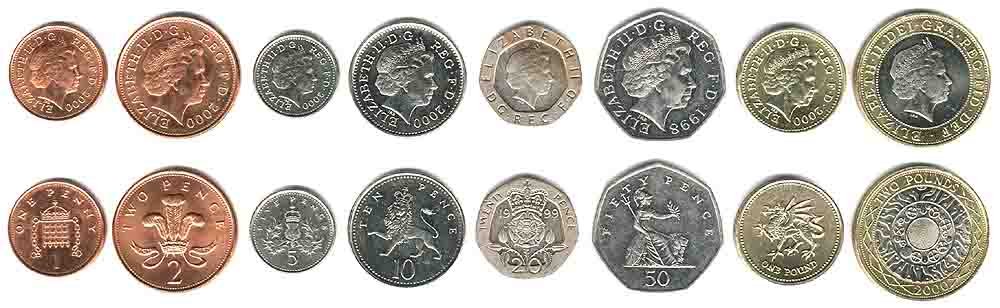
All the circulating coins have an effigy of Queen Elizabeth II on the obverse, and various national and regional designs, and the denomination, on the reverse. All current coins carry a Latin inscription whose full form is ELIZABETH II DEI GRATIA REGINA FIDEI DEFENSOR, meaning "Elizabeth II, by the grace of God, Queen and Defender of the Faith".
The circulating coins, excepting the two-pound coin, were redesigned in 2008, keeping the sizes and compositions unchanged, but introducing reverse designs that each depict a part of the Royal Shield of Arms and form the whole shield when they are placed together in the appropriate arrangement. The exception, the 2008 one-pound coin, depicts the entire shield of arms on the reverse.


Frequently used : £0.01, £0.02, £0.05, £0.10, £0.20, £0.50, £1.00, £2.00
Rarely used : £0.25, £5.00

One penny, 1p; £0.01 : Obverse = Queen Elizabeth II
Reverse = Segment of the Coat of Arms of the United Kingdom
Two pence, 2p; £0.02 : Obverse = Queen Elizabeth II
Reverse =  Segment of the Coat of Arms of the United Kingdom
Five pence, 5p; £0.05 : Obverse = Queen Elizabeth II
Reverse =  Segment of the Coat of Arms of the United Kingdom
Ten pence, 10p; £0.10 : Obverse = Queen Elizabeth II
Reverse =  Segment of the Coat of Arms of the United Kingdom
Twenty pence, 20p; £0.20 : Obverse = Queen Elizabeth II
Reverse =  Segment of the Coat of Arms of the United Kingdom
Twenty-five pence or crown, 25p; £0.25 : Obverse = Queen Elizabeth II
Reverse =  Diana, Princess of Wales and Charles, Prince of Wales
Fifty pence, 50p; £0.50 : Obverse = Queen Elizabeth II
Reverse =  Segment of the Coat of Arms of the United Kingdom
One pound, £1.00 : Obverse = Queen Elizabeth II
Reverse =  Coat of Arms of the United Kingdom
Two pound, £2.00 : Obverse = Queen Elizabeth II
Reverse =  Design by Bruce Rushin
Five pound, £5.00 : Obverse = Queen Elizabeth II
Reverse = No standard reverse design


Banknotes
Frequently used : £5.00, £10.00, £20.00
Rarely used : £50.00

£5.00 : Obverse = Queen Elizabeth II, in full view facing left
Reverse = Elizabeth Fry, showing her reading to prisoners in Newgate Prison
£10.00 : Obverse = Queen Elizabeth II, in full view facing left
Reverse = Charles Darwin, a hummingbird and HMS Beagle
£20.00 : Obverse = Queen Elizabeth II, in full view facing left
Reverse = Adam Smith, with an illustration of 'The division of labour in pin manufacturing'
£50.00 : Obverse = Queen Elizabeth II, in full view facing left
Reverse = Sir John Houblon, with a view of his house in Threadneedle Street


Tuesday, August 25, 2009

Singapore Dollar

The Singapore dollar or Dollar (sign: $; code: SGD) is the official currency of Singapore. It is normally abbreviated with the dollar sign $, or alternatively S$ to distinguish it from other dollar-denominated currencies. It is divided into 100 cents.

History
Between 1845 and 1939, Singapore used the Straits dollar. This was replaced by the Malayan dollar, and, from 1953, the Malaya and British Borneo dollar, which were issued by the Board of Commissioners of Currency, Malaya and British Borneo. Singapore continued to use the common currency upon joining Malaysia in 1963, but, two years after Singapore's expulsion and independence from Malaysia in 1965, the monetary union between Malaysia, Singapore and Brunei broke down. Singapore established the Board of Commissioners of Currency, Singapore, on April 7, 1967 and issued its first coins and notes. Nevertheless, the Singapore dollar was exchangeable at par with the Malaysian ringgit until 1973, and interchangeability with the Brunei dollar is still maintained.

Coins
Frequently used :S$0.1, S$0.2, S$0.5, S$1
Rarely used :S$0.01, S$0.05

- S$0.01 : Obverse = Coat of Arms, "Singapore" in 4 official languages
Reverse = Value, Vanda Miss Joaquim
- S$0.05 : Obverse = Coat of Arms, "Singapore" in 4 official languages
Reverse = Value, Monstera deliciosa
- S$0.1 : Obverse = Coat of Arms, "Singapore" in 4 official languages
Reverse = Value, Jasminum Multiflorum
- S$0.2 : Obverse = Coat of Arms, "Singapore" in 4 official languages
Reverse = Value, Calliandra surinamensis
- S$0.5 : Obverse = Coat of Arms, "Singapore" in 4 official languages
Reverse = Value, Allamenda cathartica
- S$1 : Obverse = Coat of Arms, "Singapore" in 4 official languages
Reverse =Value, Lochnera rosea


Banknotes
Frequently used :S$2, S$5, S$10, S$50, S$100
Rarely used : S$1,000, S$10,000

- S$2 : Obverse = President Yusof bin Ishak, Money Cowrie
Reverse = Education
- S$5 : Obverse = President Yusof bin Ishak, Gold-Ringed Cowrie
Reverse = Garden City
- S$10 : Obverse = President Yusof bin Ishak, Wandering Cowrie
Reverse = Sports
- S$50 : Obverse = President Yusof bin Ishak, Cylindrical Cowrie
Reverse = Arts
- S$100 : Obverse =  President Yusof bin Ishak, Swallow Cowrie
Reverse = Youth
- S$1,000 : Obverse =  President Yusof bin Ishak, Beautiful Cowrie
Reverse = Government
- S$10,000 : Obverse =  President Yusof bin Ishak, Onyx Cowrie
Reverse = Economics


The S$10,000 note is one of the world's most valuable banknote (that is officially in circulation).